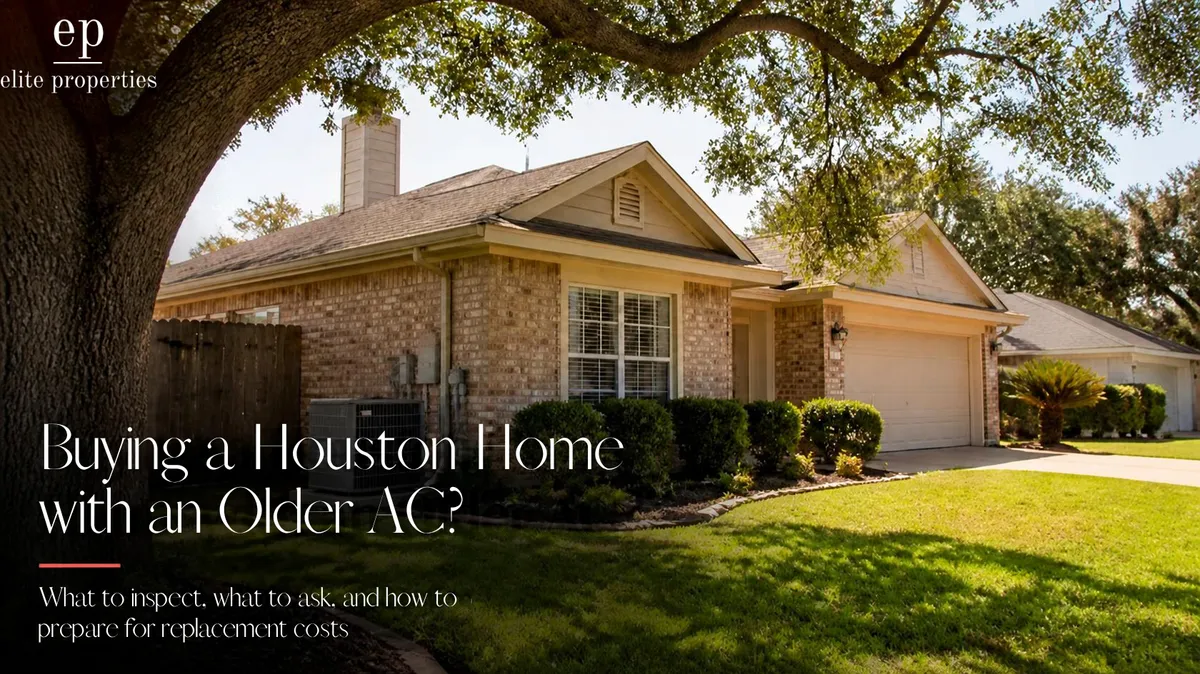
Should You Buy a Houston Home With an Older AC System?
Should You Buy a Houston Home With an Older AC System?
There are certain things Houston homeowners can live without for a little while.
A fancy refrigerator?
Sure.
Perfect landscaping?
We'll survive.
Air conditioning in August?
Absolutely not.
That's why HVAC age gets so much attention when Houston-area buyers review a home inspection.
If you're buying a house with an older AC system, you may immediately wonder:
"Am I about to spend thousands replacing this thing?"
Maybe.
Maybe not.
The age of an HVAC system is important, but just like a roof, age isn't the only thing we should evaluate.
Is an Old AC Automatically a Deal-Breaker?
No.
An older HVAC system may still be operating properly.
A newer system can have problems too.
Instead of asking only:
"How old is it?"
I want buyers asking:
"How old is it, what condition is it in, how is it performing and what should I budget for?"
That's a much better question.
Why HVAC Matters So Much in Houston
Houston's climate puts air-conditioning systems to work.
Long, hot summers mean an HVAC system can operate heavily for significant portions of the year.
That's why the condition and performance of the system deserve attention during your inspection.
Find Out the Age
Ask about the age of the:
Outdoor condenser
Indoor equipment
Furnace when applicable
Other major HVAC components
Don't automatically assume every component was replaced at the same time.
Sometimes one portion of a system has been replaced while another is older.
Ask for Maintenance Records
If the seller has HVAC maintenance records, they may provide useful information.
You might learn:
How regularly the system was serviced
Whether repairs were performed
Whether major components were replaced
Whether recurring problems existed
No records doesn't automatically mean the system was neglected.
But documentation can help.
What Can a Home Inspector Tell You?
During a general inspection, the inspector may evaluate accessible HVAC components and operation within the scope of the inspection.
The report may identify concerns such as:
Performance issues
Visible deficiencies
Drainage concerns
Duct observations
Equipment condition
Need for further evaluation
If significant concerns are identified, an HVAC professional may need to take a closer look.
What If the Inspector Says the AC Is Old but Working?
This is a very common scenario.
The report might essentially tell you:
The system is older but operating at the time of inspection.
That doesn't mean it will fail tomorrow.
It also doesn't guarantee another five years.
Now we move from a repair question to a budgeting question.
If you buy the house, are you financially prepared if replacement becomes necessary sooner than expected?
Don't Ask an Inspector to Predict the Future
No inspector can tell you the exact day an HVAC system will fail.
A system might last longer than expected.
Another may fail earlier.
Treat age and condition as information for planning rather than a countdown clock.
Should You Get an HVAC Inspection?
If the general inspector identifies significant concerns—or if the system's condition creates questions for you—additional evaluation by a qualified HVAC professional may be worthwhile.
Especially if we're still within an applicable contractual due-diligence period, better information can help you make a better decision.
How Much Does AC Replacement Cost?
There isn't one universal number.
Replacement cost can depend on:
Home size
Equipment size
Efficiency
System type
Ductwork
Installation requirements
Equipment selected
Other property-specific factors
Don't rely on your cousin's replacement cost from five years ago.
Get a property-specific estimate when appropriate.
Can You Negotiate an Old AC?
Potentially.
But let's distinguish between:
Old
and
Defective.
If the system is older but functioning properly, the seller may not view age alone as a reason to provide a concession.
If the inspection or HVAC evaluation identifies a significant problem, you have more specific information for a potential negotiation.
Depending on your contract and circumstances, possible approaches might include:
Repair
Replacement
Allowable seller contribution
Price negotiation
Another agreed solution
Proceeding as-is
The seller doesn't automatically have to agree.
Should You Ask the Seller to Replace It?
Maybe.
But if the seller agrees, find out what you're actually getting.
The least expensive replacement the seller can find may not be the system you would have selected yourself.
Ask about:
Equipment
Efficiency
Installer
Warranty
Scope of work
Sometimes a buyer may prefer another negotiated solution and handle the replacement later.
Financing and contractual considerations can affect the options available.
Is a Seller Credit Better?
Potentially.
If allowed by the loan program and transaction, a negotiated seller contribution may be more useful to some buyers than a price reduction.
Why?
Because lowering the purchase price by $10,000 may only reduce a 30-year mortgage's principal-and-interest payment by a relatively modest amount each month.
It doesn't put $10,000 in your checking account for an HVAC replacement.
An allowable seller credit may help with eligible transaction costs, potentially allowing you to preserve more of your own cash.
Talk to your lender about what is permitted.
What About a Home Warranty?
A seller or buyer may consider a home warranty in some transactions.
But don't assume a warranty means:
"If the AC dies, I get a brand-new system for free."
Read the contract.
Home warranties can have:
Coverage limits
Exclusions
Service fees
Repair requirements
Other terms
A warranty can be part of your planning, but it isn't a substitute for understanding the system's condition.
Your Electric Bill Matters Too
An older system may still cool the house, but efficiency can also affect operating costs.
Ask questions about:
Equipment efficiency
Insulation
Ductwork
Thermostat
Home size
Windows
Overall energy efficiency
The HVAC system is only one part of how efficiently a home cools.
Don't Forget the Attic
In Houston, attic conditions can make a noticeable difference in comfort.
During due diligence, inspection observations involving things such as insulation, ventilation and ductwork may also be worth understanding.
A newer AC doesn't automatically fix every comfort or efficiency problem.
Look at the Entire House
Suppose you're comparing two homes.
Home A
Lower price, but:
Older roof
Older HVAC
Older water heater
Home B
Costs $15,000 more, but several major systems were recently replaced.
Which is the better deal?
You can't answer based on price alone.
We need to evaluate:
Purchase price + condition + immediate repairs + future expenses + monthly costs.
That's the real comparison.
This Is Why Cash Reserves Matter
Imagine closing with $300 left in your savings account.
Then the AC stops cooling two months later.
That's not the welcome-to-homeownership moment we want.
When deciding how much cash to put toward a down payment, also think about what you'll have left after closing.
A house needs a reserve fund.
Especially if you're knowingly purchasing older major systems.
Should You Walk Away Because the AC Is Old?
Not automatically.
Ask:
Is it working properly?
What did the inspector observe?
Does an HVAC professional need to evaluate it?
Are maintenance records available?
What might replacement cost?
How much savings will I have after closing?
Do the purchase terms still make sense?
Then decide whether you're comfortable with the risk.
What If the AC Stops Working Before Closing?
If something materially changes with the property's condition before closing, contact your real estate agent.
The contract and circumstances will determine what happens next.
Don't wait until after signing to mention something you noticed during the final walkthrough.
New Construction HVAC Still Deserves Attention
Brand-new HVAC equipment should still be part of an independent inspection when appropriate.
New construction can have installation or performance issues too.
New doesn't mean we skip due diligence.
Think Beyond the Purchase Price
This is one of the biggest lessons I want Houston buyers to understand.
The cheapest house isn't automatically the least expensive house to own.
A property may look like a great deal until you discover you're potentially budgeting for:
Roof
HVAC
Water heater
Plumbing
Foundation work
within the first few years.
Another home with a slightly higher price but better major systems may create a completely different ownership experience.
Final Thoughts
Should you buy a Houston home with an older AC system?
Maybe.
An older system isn't automatically a reason to walk away.
But it should become part of your due diligence and financial planning.
Evaluate:
Age + Condition + Performance + Maintenance + Replacement Cost + Your Savings
The goal isn't to find a house where nothing will ever break.
That house doesn't exist.
The goal is to understand what you're buying and make sure you're financially prepared to own it.
About Marysol Calvillo
I'm Marysol Calvillo, a real estate broker helping buyers throughout Katy, Cypress, Hockley, 77084, 77095 and the greater Houston area evaluate more than the countertops and paint colors.
I help buyers look at the major systems, inspection findings, monthly costs and potential future expenses so they can make a more informed home-buying decision.
Call to Action
Looking at a Houston-area home with an older HVAC system? Let's evaluate the complete property—not just its list price—so you understand the inspection findings, potential future expenses and how much cash you may want to keep available after closing.